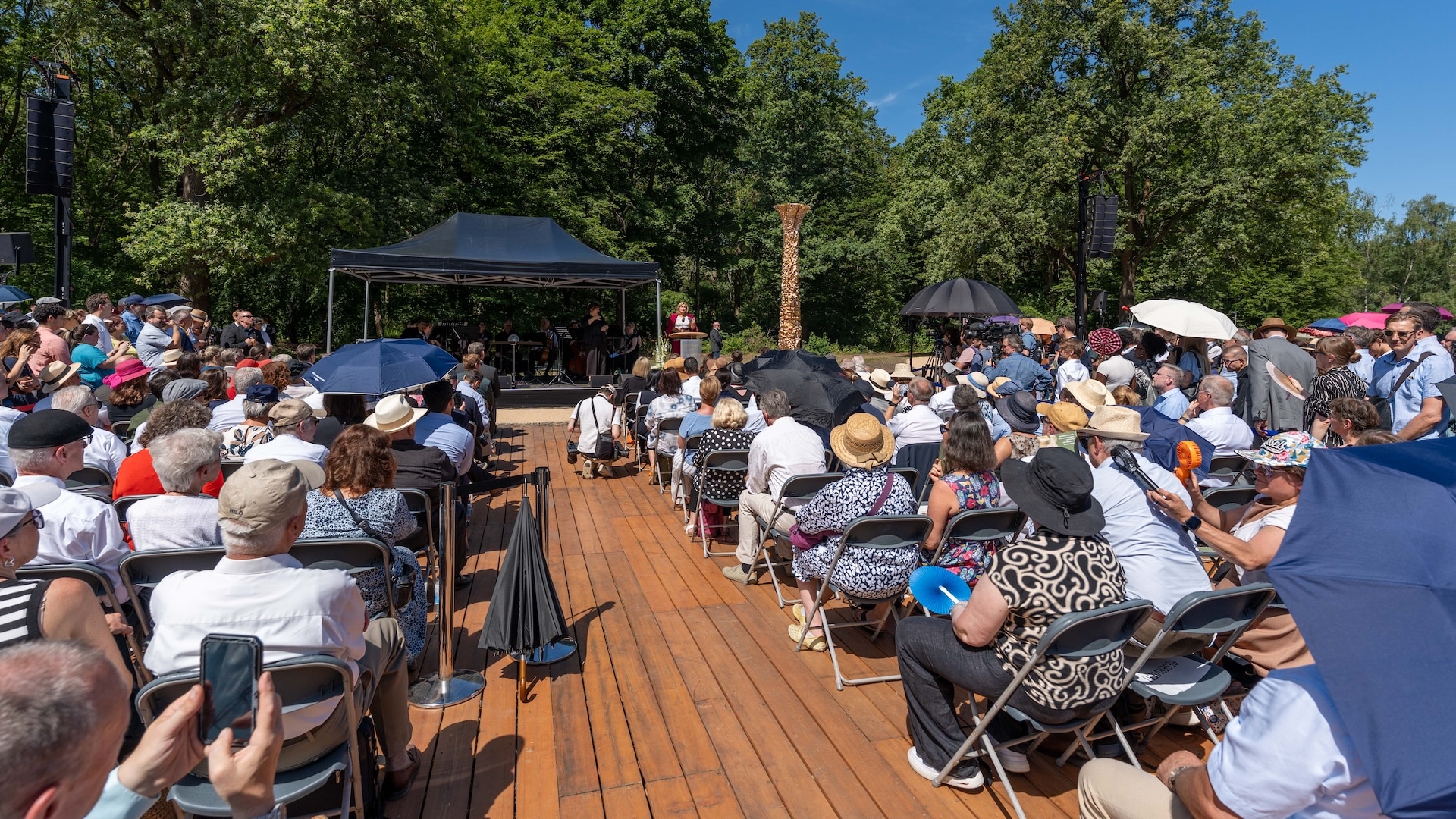
On the day before the dedication to the public of the memorial to Jehovah’s Witnesses persecuted and murdered under National Socialism, the Arnold-Liebster-Stiftung invited guests to an event at the Akademie der Künste on Pariser Platz—very close to the Brandenburg Gate and the Großer Tiergarten, where this same ceremony—the dedication of the memorial—took place the following day. Guests from Denmark, Canada, Greece, Luxembourg, Austria, Sweden, Slovenia, Spain and the United States—and many more who watched the event via livestream around the world—experienced an afternoon of reflection, gratitude and responsibility, and focused on one question: Why did these people remain steadfast, and what does their legacy mean for us today?
A welcome address that set the tone
The afternoon opened with the chamber orchestra Terra Nova, conducted by Jerome Weiss, performing Erich Frost’s piece “Fest und entschlossen”—Frost was one of the Goldfischteich activists, survived Nazi persecution, and his song was later to play a special role in the design of the memorial. Video from 00:01:05
Moderator Uwe Klages, chair of the Arnold-Liebster-Stiftung, gave a special welcome to those among the guests who had campaigned for the memorial over the years—including former Minister of State for Culture Claudia Roth, Bundestag member Thomas Hacker, as well as Uwe Neumärker, director of the Stiftung Denkmal für die ermordeten Juden Europas, and his team. Video from 00:07:44
Founder Simone Arnold-Liebster, now 96 years old, joined by video. Her welcome address placed conscience at the center: The victims had seen themselves “not as heroes,” “but as weak and fallible people who wanted to listen to their conscience.” Their memory carried an important message: “Human beings have the ability to listen to and follow their inner voice. The decision rests with each individual.” Video from 00:16:07
From the “forgotten victims” to a culture of remembrance
Professor Detlef Garbe, a historian and former director of the KZ-Gedenkstätte Neuengamme, traced how long the history of the persecution of Jehovah’s Witnesses went unexamined by scholars: Not a single historical study of the subject appeared during the first decades after the war. A broad field of research developed only from the 1990s onward. Today, almost 500 Stolpersteine and nearly 30 street names in Germany commemorate persecuted Jehovah’s Witnesses. The website biographien-verfolgter-zeugen-jehovas.de, created in conjunction with the memorial, already presents 568 biographies and documents 154 places of remembrance—given more than 15,500 documented cases of persecution, this is a project that needs to be continued. Garbe called the Bundestag’s cross-party, unanimous resolution for the memorial on June 22, 2023 a “truly remarkable event”: With the dedication, at the latest, it would no longer be possible to speak of Jehovah’s Witnesses as being among the forgotten victims. Video from 00:19:16
James Pellechia from New York recalled an anniversary: Thirty years ago, on November 6, 1996, the documentary “Jehovah’s Witnesses Stand Firm Against Nazi Assault,” in which he played a major role as producer, premiered at the Ravensbrück Memorial. Since then, more than 2.5 million copies in 40 languages have been distributed worldwide; in Germany alone, more than 800,000 people saw the film or the accompanying exhibition. The film had transformed history “from statistics into human stories”—and had planted a tiny seed that, Pellechia said, had now grown into a “magnificent tree of remembrance.” Video from 00:35:57 (Talk in English)
The long road to the memorial
Professor Wolfgang Benz spoke under the title “Verweigerte Erinnerung” about the difficult path toward a commemorative marker. Jehovah’s Witnesses—around 25,000 believers at the time—were the only religious community that, as a whole and consistently, resisted National Socialism because of their faith. They refused the Hitler salute, the oath and military service, helped persecuted Jews—as did the Berlin couple Franz and Emma Gumz, who hid Inge Deutschkron—and were banned, convicted and deported to concentration camps as a result. Their exclusion continued after 1945: In the GDR, Jehovah’s Witnesses were banned again in 1950. Benz spoke openly about the resistance encountered on the road to the memorial—from proposals to relegate it to the outskirts of the city to heritage conservation objections to the location. His conclusion: “Commemorating the persecution and courageous resistance of Jehovah’s Witnesses with a marker in a public space was long overdue.” Video from 00:52:27
Uwe Neumärker placed the new memorial in the context of the work of the Stiftung Denkmal, which since the Bundestag resolution of 1999 has been committed to the dignified remembrance of all victims of National Socialism—“there must be no first- or second-class victims.” He recalled the Bundestag session on June 22, 2023, when representatives of the foundations watched the resolution being adopted from the visitors’ gallery, and thanked all its political supporters. He highlighted one special feature: It is the first commemorative marker (Gedenkzeichen) in the Foundation’s portfolio that the Bundestag has officially designated a “Mahnmal”—a memorial intended both to commemorate and to warn. Video from 01:10:03
A tree made of twelve tonnes of bronze
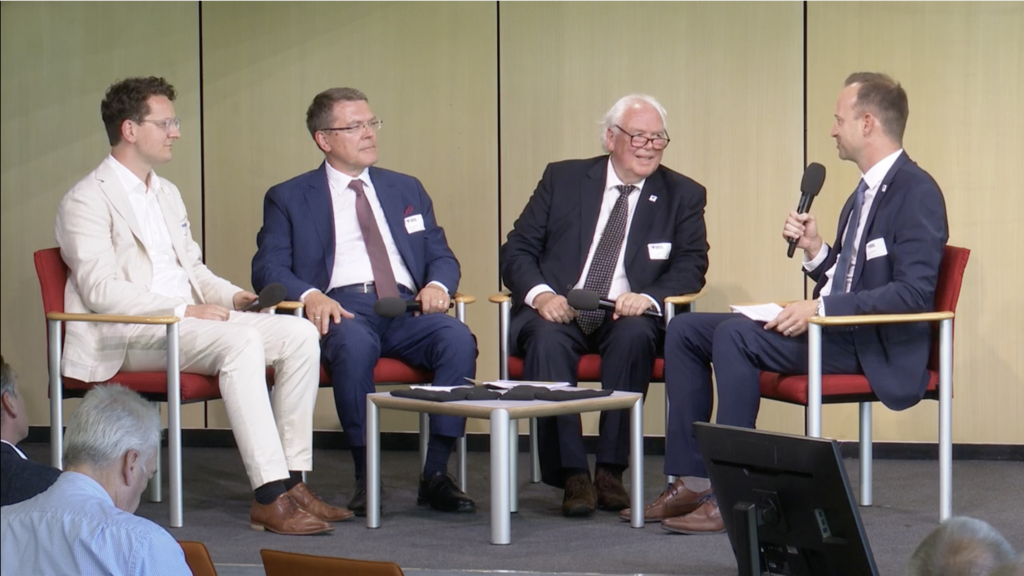
In conversation with Mario Bergmann, Uwe Klages, board member Uwe Langhals and German-Italian sculptor Matthias Leeck described how the memorial came into being. With humor, Langhals described the “period of lateral passes” through Berlin’s administrative offices, until it became clear: It would not be possible without a Bundestag resolution. Leeck explained his design: The four-and-a-half-meter-high sculpture, made of twelve tonnes of solid bronze, fits into an empty space in the park like a tree—ten more trees will be planted in the fall. Worked into its surface is a “layering of memory” made up of historical photographs of persecuted Jehovah’s Witnesses and his own photographs from present-day memorial sites. Even the sculpture’s outline tells a story: The composer Guido Mallardi condensed Erich Frost’s song “Fest und entschlossen” into a single sound, whose frequency curve is reflected in abstract form in the sculpture’s shape. Video from 01:20:59
The historic site: the Goldfischteich in the Tiergarten
Why does the memorial stand in that exact location? In conversation with Micha Kours, historian Angela Nerlich spoke about her seven years of research: An interrogation transcript from 1936 and the related written judgment expressly identify the Goldfischteich in Berlin’s Tiergarten as the resistance group’s meeting place—there, at the deck-chair rental business run by a fellow believer, leaflets were handed over and meetings were arranged. Her research even brought to light a previously unknown thirteenth Goldfischteich activist: Franz Kassing, who managed the illegal production of phonograph records and a secret store of literature. For Nerlich, the tree sculpture reflects the activists’ inner character: firmly rooted, striving upward, on a footprint of just one square meter—“They simply stand upright.” Video from 01:36:28
Verena Kours offered a very personal perspective. She is the granddaughter of Goldfischteich activist Otto Kours, who died in the Sachsenhausen concentration camp in January 1940. She spoke on behalf of the descendants and later generations. Around 22 members of the activists’ families were in the room—many had met only through the memorial project. More than 15,500 Jehovah’s Witnesses were persecuted, more than 4,500 were sent to concentration camps, and more than 1,800 died. “We must never forget what can happen when people look away,” Kours said. For the relatives, the memorial meant “that the burden is now a little lighter. It is shared and made known.” Video from 01:46:20
Persecution is not a thing of the past
The interview with Dennis and Irina Christensen from Denmark made clear that freedom of conscience cannot be taken for granted even today. Dennis Christensen was imprisoned in Russia from 2017 to 2022—solely because of his faith as one of Jehovah’s Witnesses. He drew strength from “faith, hope and love”—and from a letter by Simone Arnold-Liebster, whose book “Facing the Lion” had a profound influence on him. At present, at least 278 Jehovah’s Witnesses worldwide are imprisoned because of their faith, 161 of them in Russia. Video from 01:54:09 (Interview in English)
A quiet highlight: Ninety-year-old Johannes Haufe, himself persecuted in the GDR, described how he prays by name each day for those imprisoned today. Video from 02:08:25
Remembrance as a responsibility
Peter Stocker of the Austrian association Lila Winkel, whose family, the Wohlfahrt family, had 22 members who were persecuted, argued that remembrance should be motivated not by duty but by responsibility: When family histories are told, “the victims are given faces; stories come alive.” Video from 02:11:09
To conclude, historian Falk Bersch reviewed the state of the culture of remembrance: More than 580 commemorative markers in Germany today commemorate Jehovah’s Witnesses—Stolpersteine, street names, steles and plaques; the first two Stolpersteine ever legally laid, in 1997, were dedicated to two Jehovah’s Witnesses. The new website biographien-verfolgter-zeugen-jehovas.de makes these places discoverable as a digital memorial site—developed by a large team of volunteers, including six youth project groups with more than 50 young people from eastern and western Germany. Video from 02:19:09
With Jerome Weiss’s piece “Ungebrochen durch die Nacht,” the chamber orchestra Terra Nova brought to a close an afternoon whose message Angela Nerlich perhaps expressed most succinctly: “No human being has the right to obey injustice.” Video from 02:29:10
On the following day, June 24, 2026, the memorial on Straße des 17. Juni, near the Goldfischteich in the Großer Tiergarten, was formally handed over to the public. Our report: Memorial for Persecuted Jehovah’s Witnesses Formally Dedicated. A documentation volume on the event—with a foreword by Claudia Roth—will be published at the end of the year.