
In bright sunshine, a new memorial was formally dedicated on Wednesday, June 24, 2026, at 11:00 AM at the Goldfischteich in Berlin’s Tiergarten. It commemorates the Jehovah’s Witnesses (Bible Students) who were persecuted, deported to concentration camps, and murdered during the National Socialist era. The formal dedication gave a victim group whose history long stood in the shadow of other chapters of German remembrance culture a visible place of commemoration.
The dedication ceremony, attended by around 1,000 guests, made one thing clear: this memorial is more than just a new stop on Berlin’s path of remembrance. It is a symbol of freedom of conscience, religious tolerance, and the duty to tell publicly even those stories that are uncomfortable or have long been suppressed.
A Unanimous Resolution and Late Recognition
On June 22, 2023, the German Bundestag unanimously passed a resolution to establish the memorial. At the official dedication ceremony, President of the German Bundestag Julia Klöckner recalled that such unity in parliament cannot be taken for granted. For this very reason, the resolution carries particular weight: the persecution of Jehovah’s Witnesses under National Socialism was to receive a permanent, dignified place in public remembrance. Video starting at 00:08:50
In her speech, Klöckner focused on the individual. Her point was that the memorial is dedicated to those who suffered grave injustice and yet preserved their humanity. Video starting at 00:13:46
With this, Klöckner touched on a central point of the dedication ceremony. Jehovah’s Witnesses are among the victim groups of National Socialism that were long overlooked. According to Klöckner, their faith remained foreign and suspect to many, and their suffering therefore received less recognition. Prejudices also persisted after 1945, and persecution even continued in the GDR. Consequently, the path to a visible place of remembrance was a long one. The new place of remembrance therefore also corrects the historical record by making visible what had long been overlooked.
Conscience Against Violence
In his subsequent address, Minister of State for Culture and the Media Wolfram Weimer placed a clear emphasis on conscience. He asked why dictatorships fear believers and why a totalitarian state perceives the quiet steadfastness of individuals as a threat. Video starting at 00:21:03
His answer went to the heart of the memorial: anyone who says no on grounds of conscience resists absolute power’s demand for obedience. Jehovah’s Witnesses did not seek to overthrow the regime. They wanted to practice their faith. Yet it was precisely this insistence on a higher moral obligation that made them a threat in the eyes of the Nazi regime. Video starting at 00:22:01
Weimer also recalled August Dickmann, who was shot at Sachsenhausen concentration camp in 1939 for refusing military service on grounds of conscience. His story represents many others who were not prepared to surrender their conscience to the state. Video starting at 00:21:34
Why the Bible Students Were Persecuted
The National Socialists persecuted Jehovah’s Witnesses with particular severity because they rejected the regime’s totalitarian demands. They did not give the Hitler salute, did not join the NSDAP, did not participate in the cult of the Führer, and refused military service on grounds of conscience. Many continued their religious activities despite the ban.
The speeches also recalled that Jehovah’s Witnesses helped other persecuted people. Emma and Franz Gumz from Berlin are one example. The couple supported the Jewish Deutschkron family; Emma Gumz was later honored as Righteous Among the Nations. Such stories show that resistance was not always loud. Sometimes it meant refusing to go along, sharing food, hiding people, or maintaining contact with other persecuted individuals at great personal risk. Video starting at 00:11:15
According to the figures cited at the ceremony, thousands of Jehovah’s Witnesses from Germany and the occupied countries of Europe were targeted by the Nazis. More than 15,000 were persecuted or imprisoned, and many were deported to concentration camps. At least 1,700 did not survive the persecution. In the camps, Bible Students were marked with the purple triangle. Figures starting at 00:20:34 · Purple triangle starting at 00:12:41
The Goldfischteich as a Historic Site
It is no coincidence that the memorial stands at the Goldfischteich. Jehovah’s Witnesses met secretly near this location during the Nazi era. Under the guise of a chair rental business, they exchanged information and maintained connections within their banned community. Video starting at 00:20:06
Berlin’s Senator for Justice Felor Badenberg recalled this historical context in her speech. The Goldfischteich is a place where resistance and persecution, self-assertion and state violence intersected. In August 1936, the Gestapo struck there. Several Jehovah’s Witnesses were arrested; the site became the scene of a wave of persecution that reached far beyond Berlin. Video starting at 00:36:16
Badenberg drew a clear lesson for the present from this. From the perspective of the justice system in particular, injustice must be named as such. Courts and public prosecutors did not merely tolerate National Socialist injustice; in many cases, they enforced it. The memorial therefore also points to the responsibility of a state governed by the rule of law to protect freedom of conscience and religion. Video starting at 00:38:36
A Bronze Sculpture Like a Wounded Tree
The memorial was created by artist Matthias Leeck. The sculpture is five meters high and made of bronze. In the speeches, it was described as a tree whose branches have been removed, yet which remains firmly rooted. This form was chosen deliberately: it is intended to convey injury without allowing helplessness to have the final word. Video starting at 00:18:50
Leeck himself spoke about the artistic struggle involved in giving form to such a subject. How can suffering be captured in bronze? How can a work commemorate persecution without reducing the victims to their suffering? His answer is a sculpture that reaches upward. It appears damaged, but not broken. Video starting at 00:41:21
The surface incorporates tonal values of light and shadow from photographic fragments of concentration camp memorial sites and historical documents. In this way, memory becomes inscribed in the bronze—not as a direct depiction, but as a trace: visible, tangible, and permanent. Video starting at 00:43:05
Particularly powerful was Leeck’s idea that the site should not be a space devoted solely to mourning. Visitors should not stand frozen in solemnity. They should come, look, linger, and perhaps also enjoy the sun. In this way, the freedom to enjoy life in the park becomes part of the answer to the tyranny of the past. Video starting at 00:45:33
Voices of Descendants: Putting Faces to History
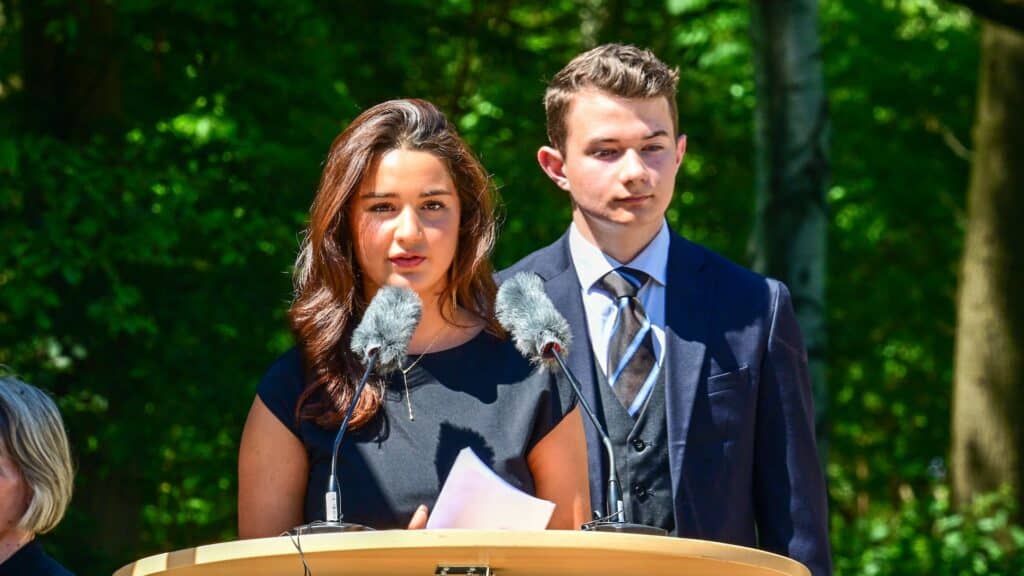
Among the most moving moments of the dedication ceremony were the accounts shared by descendants of persecuted Jehovah’s Witnesses. They told of families whose daily lives were shattered by arrest, loss of employment, loss of housing, and imprisonment in concentration camps. They spoke of fathers who did not return, of mothers who cared for their children under the most difficult conditions, and of children who were punished at school simply for refusing the Hitler salute.
The program featured Clara-Denise Dörner, the great-granddaughter of Bruno Seide, who was persecuted, and Julius Glaser, the great-great-grandson of Wilhelm Ruhnau, who was also persecuted. Their contributions brought history out of abstract remembrance: those who had been persecuted emerged again as individuals with families, occupations, children, decisions, and descendants who speak their names today. Clara-Denise Dörner starting at 00:49:45 · Julius Glaser starting at 00:53:59
These personal memories gave the memorial a second dimension. Numbers are necessary to grasp the scale of the persecution. But only family stories show what persecution meant in individual lives: dismissal from a job, emergency accommodation, fear of the Gestapo’s next visit, the last sign of life from detention, and silence after the war.
These voices in particular made it clear why places of remembrance are needed. They do more than preserve the memory of the past. They create a public space where descendants can say: This happened. And it belongs to our shared history.
A Memorial for Dignity and Freedom of Conscience
At the end of the ceremony, the memorial was formally dedicated. Berlin’s Tiergarten now has a place that commemorates a long-overlooked victim group while posing an urgent question for the present: What is a conscience worth when power demands obedience? Video starting at 01:06:20
The memorial’s answer is quiet but clear. It lies in the five-meter-high bronze, in the history of the Goldfischteich, in the names of the persecuted, and in the voices of their descendants. It says: Human dignity remains inviolable—even where a regime does everything in its power to break it.
Press Reports
- ABC (Paraguay)
- Bayerischer Rundfunk (BR)
- Berliner Morgenpost
- Minister of State for Culture and the Media (BKM)
- German Bundestag
- Deutschlandfunk
- dpa International
- Evangelische Zeitung
- Der Tagesspiegel
- Instagram (RBB24)
- Instagram (JW Pressroom)
- Jehovah’s Witnesses
- Jüdische Allgemeine
- Kreismuseum Wewelsburg
- Libération (France)
- La Libre (Belgium)
- La Vanguardia (Spain)
- Villa Merländer (NS-Dokumentationsstelle Krefeld)
- Orange Actualités (France)
- ORF Religion (Austria)
- RP Online
- rbb24
- stern
- taz
- TV5 Monde (France)
- Die Verleugneten (VEVON)—Press Release
- WDR 5 – Morgenecho
- Die Welt
- Yahoo News (English)
- zeitzeichen
Video Recordings
Facts About the Memorial for Persecuted Jehovah’s Witnesses
Location: Goldfischteich in Berlin’s Tiergarten
Occasion: Commemoration of Jehovah’s Witnesses persecuted and murdered under National Socialism, often known at the time as Bible Students
Official Dedication: June 24, 2026
Bundestag Resolution: June 22, 2023, unanimous
Artist: Matthias Leeck
Design: Five-meter-high bronze sculpture, based on the shape of a wounded but steadfast tree
Historical Reference: Secret meetings of Jehovah’s Witnesses at the Goldfischteich, arrests by the Gestapo in 1936
Descendants in the Program: Clara-Denise Dörner, great-granddaughter of Bruno Seide, who was persecuted; Julius Glaser, great-great-grandson of Wilhelm Ruhnau, who was persecuted
FAQ
Why is there a memorial for Jehovah’s Witnesses in Berlin?
The memorial commemorates Jehovah’s Witnesses who were persecuted, imprisoned, and murdered for their faith under National Socialism. It brings visibility to a victim group whose history long received less attention.
Where is the memorial located?
The memorial is located at the Goldfischteich in Berlin’s Tiergarten. The site was chosen because Jehovah’s Witnesses met there secretly during the Nazi era, and the Gestapo carried out arrests there in 1936.
Who created the memorial?
The bronze sculpture was designed by artist Matthias Leeck. It resembles a damaged but steadfast tree.
Why were Jehovah’s Witnesses persecuted under National Socialism?
Among other things, they refused the Hitler salute, did not join party organizations, rejected the cult of the Führer, and refused military service on grounds of conscience. In doing so, they resisted the totalitarian demands of the Nazi regime.
What does the purple triangle mean?
The purple triangle was the badge used to mark Bible Students and Jehovah’s Witnesses in concentration camps.