
History is currently being milled in a metalworking shop in Wermelskirchen, Germany – literally. The memorial to Jehovah’s Witnesses persecuted and murdered under National Socialism, which is to be formally dedicated in Berlin’s Tiergarten park on June 24, 2026, is being built there.
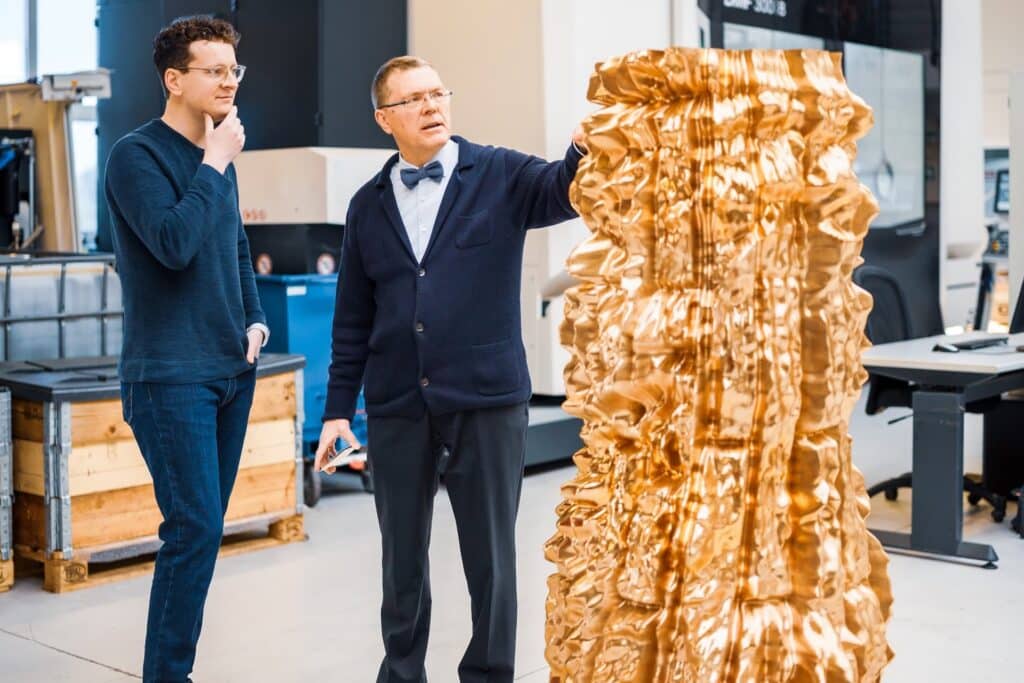
It is a special moment for Matthias Leeck. Today, in a metal workshop in Wermelskirchen, the artist is able to hold parts of his work in his hands for the first time – the bronze sculpture that is to be formally dedicated as a national memorial in Berlin’s Tiergarten in less than three months. What previously existed only as a virtual model and a vision in the artist’s head is now becoming tangible: a bronze tree trunk almost five meters high and weighing around twelve metric tons, which will soon stand near the Goldfischteich (goldfish pond) in the Großer Tiergarten.
A tree as a symbol of steadfastness
The memorial is in the shape of a tree – and that is no coincidence. The sculpture is intended to symbolize the steadfastness of a group of victims who resisted from the first day of the National Socialist dictatorship. The Jehovah’s Witnesses, also known at the time as the Earnest Bible Students, refused to salute Hitler, rejected membership in Nazi organizations and refused to do military service. They paid a high price for this: almost 14,000 men and women were imprisoned and over 4,200 were deported to concentration camps, where they were stigmatized with a purple triangle. At least 1,700 of them lost their lives.
The tree stands – it does not bend, it does not break. And yet it bears visible traces. The surface structure of the memorial makes the injuries suffered by this group of victims visible. Scars and cuts run through the bronze. They are not only visible, but tangible – anyone who touches the memorial can feel the suffering under their fingertips.
A place with history
The location in Berlin’s Tiergarten near the Goldfischteich was chosen deliberately. On August 22, 1936, the Gestapo carried out a targeted arrest operation there against leading members of the religious community. The Goldfischteich was also a place where Jehovah’s Witnesses held secret meetings – a place of silent resistance that now became a place of public remembrance.
The memorial thus joins the memorial landscape of the Tiergarten, not far from the Memorial to the Murdered Jews of Europe and the memorials to the persecuted homosexuals, the murdered Sinti and Roma and the victims of the Nazi “euthanasia” murders.
A long road – and a great hope
15 years of intensive efforts lie behind the memorial. On June 22, 2023, the German Bundestag unanimously passed the resolution to erect it – almost exactly 90 years to the day after the religious community was banned in Prussia. The project is being implemented by the Foundation Memorial to the Murdered Jews of Europe and financed by the Federal Government Commissioner for Culture and the Media.
Construction work has been underway at the site since March 2026. In addition to the sculpture, an information board, an access path and plantings will complete the memorial site. In addition, the “Biographies of persecuted Jehovah’s Witnesses” project is creating an interactive map with places of resistance and persecution – a living digital memorial that complements the bronze memorial.
Uwe Langhals, board member of the Arnold-Liebster-Stiftung, which has been committed to remembering the persecuted Jehovah’s Witnesses for years, is following the project with great interest. His hope is that the memorial will make many people think. To think about what happens when religious freedom is trampled on. To think about what civil courage means – and what it can cost.